
The task
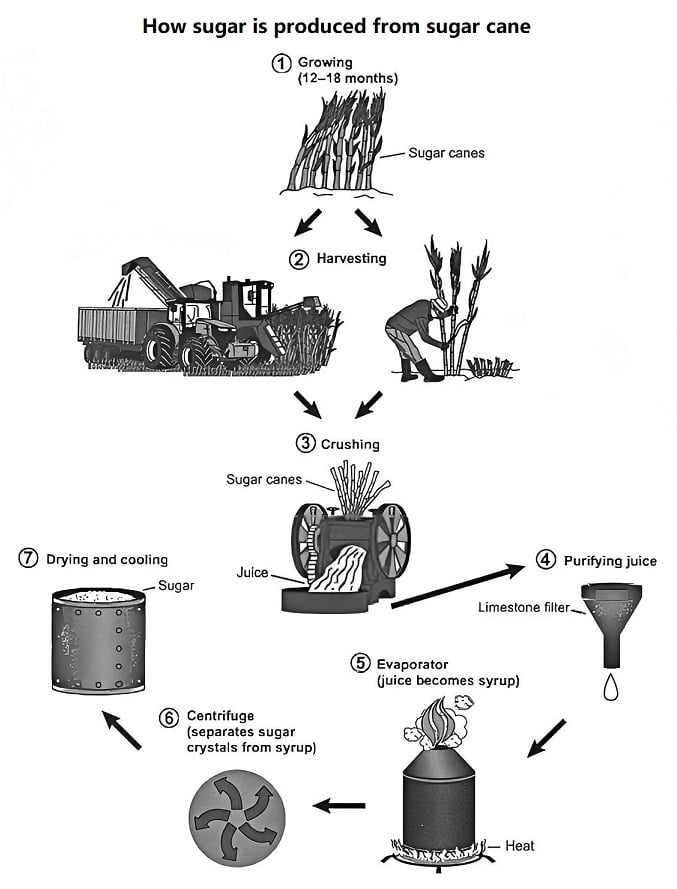
The diagram below shows the manufacturing process for making sugar from sugar cane. Summarise the information by selecting and reporting the main features, and make comparisons where relevant. Write at least 150 words.
How to write about a process
A process diagram has no numbers to compare. It shows how something is made or how something happens, one stage after another. Your job is to describe every stage, in order, so that someone who cannot see the picture could follow it.
Five steps
- Analyse. Count the stages. Find the start and the end. Decide: made by people, or by nature?
- Introduction. The task in your own words, one sentence.
- Overview. Overall or It is clear that + how many stages + the first and the last. No details.
- Body 1. The first half of the stages.
- Body 2. The second half, to the end.
Made by people or by nature?
| Made by people (sugar) | Nature (water cycle) | |
|---|---|---|
| Verbs | passive: sugar canes are grown | active: water evaporates |
| Overview | The process begins with … and ends with … | Three main stages are shown. Water … and eventually … again. |
| Last sentence | … is ready for consumption. | … to complete the cycle. |
From label to verb
The labels on a man-made diagram are usually nouns. Do not copy them. Turn each one into a passive verb: is / are + past participle.
| The diagram says | You write |
|---|---|
| Growing | Sugar canes are grown for 12 to 18 months. |
| Crushing | The canes are crushed. |
| Purifying juice | The juice is purified. |
| Drying and cooling | The crystals are dried and cooled. |
Sequencers
| Where | Say |
|---|---|
| The first stage | First, … · The process begins with … · Beginning at … |
| Start of a sentence | Next, … · After that, … · At the third stage, … |
| Inside the verb | are then harvested · is then heated |
| The last stage | Finally, … |
Saying why
| Use | Example |
|---|---|
| to + verb | The syrup is centrifuged to release sugar crystals. |
| so that + clause | It is heated so that excess water evaporates. |
| In order to + verb, … | In order to extract sugar, the juice is purified. |
2. Passive for people, active for nature. Sugar canes are grown, but water evaporates.
3. Only what the picture shows. No temperatures, no opinions about sugar.
Aim
Students build a band 9 report on Cambridge 16, Test 2 one part at a time and see it whole only at the end. The structure is new: an overview that counts stages instead of describing trends, and two body paragraphs that split the stages where the material changes, from cane to juice. The grammar is the present simple passive made from the diagram's noun labels, sequencers, and purpose. Then a second, natural process, the water cycle, so students see that the passive is a habit for factories, not a rule for every process.
Anticipated problems
- Copying the labels. Then is evaporator. The label is a noun. Stage 4, Part A turns every label into a verb.
- Active or missing be. The canes crush into juice, Sugar canes grown for 12 months. Ask: can a cane crush itself?
- is / are. The juice are purified. Juice is uncountable, canes and crystals are plural.
- Half a stage. Stage 2 shows two ways of harvesting. Students who mention only the machine have missed half the stage.
- Passive everywhere. After an hour of sugar, students write water is evaporated in the water cycle. Stage 8 exists for this.
- Inventing. The juice is heated to 100 degrees. Not in the picture, so not in the report.
Materials
This page. Students join with the room link, so their typing appears on the dashboard. A board for the label-to-verb list in Stage 4 and the passive / active contrast in Stage 8.
Timing map
| Stage | Focus | Worksheet | Min |
|---|---|---|---|
| 1 | Analyse the sugar diagram | 1 | 10 |
| 2 | Introduction | 2 | 7 |
| 3 | Overview | 3 | 10 |
| 4 | Passive, sequencers, purpose | 4 | 15 |
| 5 | Write Body 1 | 5 | 10 |
| 6 | Write Body 2 | 6 | 10 |
| 7 | Compare with the sugar model | Model | 8 |
| 8 | Water cycle: read it, active or passive | 7 (A, B) | 12 |
| 9 | Water cycle: write, then the model | 7 (C), model | 18 |
Procedure
Stage 1: Analyse the sugar diagram
Interaction: Pairs, then whole class
Put the diagram up. Ask: Are there any numbers to compare? (Only 12 to 18 months.) So what do we write about? Aim for: what happens, in order.
Read How to write about a process up to the five steps together (2 minutes). Pairs do Worksheet 1 in 5 minutes, with a finger on each stage. Check aloud. Stop on 3: both ways of harvesting must go in the report. Stop on 9 and 10: man-made, and a line with a start and an end. Say: at the end of the lesson we will see one made by nature.
Stage 2: Introduction
Interaction: Individual, then pairs
Rule on the board: same meaning, different words. Students do Worksheet 2. The best swap in Part A is the manufacturing process for making sugar becoming the various steps in the production of sugar. Point out the raw material sugar cane: a band 9 phrase for where a product starts. In Part B only B is right. Make them name the fault in the other three:
- A is the task with three words added.
- C adds a detail (12 to 18 months). That belongs in Body 1.
- D is only about growing. The diagram goes all the way to sugar, so the meaning is wrong.
Stage 3: Overview
Interaction: Individual, then pairs
Open with the stakes: no proper overview, no band 7. Ask: In a line graph the overview gives the main trends. There are no trends here. What can we say? Aim for: how many stages, how it starts, how it ends.
Students do Part A of Worksheet 3 (overview or body), then judge the three samples in Part B and write their own in Part C. Checklist on the board: Overall / It is clear that · number of stages · first and last · no machines, no details.
Stage 4: Passive, sequencers, purpose
Interaction: Whole class, then individual
Write on the board and ask what is wrong:
Answer: the first copies the label, the second needs the passive (a cane cannot crush itself), the third has are with an uncountable noun. Correct version: The juice is then heated in an evaporator. The canes are crushed into juice. The juice is purified.
Point at From label to verb in the guide. Students do Parts A and B of Worksheet 4 (7 minutes). Stop on 6: the model says is centrifuged, a verb made from the machine. is spun is the everyday word. Stop on 9: then goes inside the verb.
Then Part C. Do number 12 together on the board:
→ The juice is heated so that excess water evaporates.
Say it plainly: a list of stages is band 6; saying why a stage happens is band 7 and above. Students do 13 and 14 alone.
Stage 5: Write Body 1
Interaction: Individual
Ask: seven stages, two paragraphs. Where do you split? Answer: after stage 3. Stages 1 to 3 turn the plant into juice, 4 to 7 turn the juice into sugar. Students build Body 1 on Worksheet 5. Walk the room and check: every verb passive, both harvesting methods in.
Stage 6: Write Body 2
Interaction: Individual
Students build Body 2 on Worksheet 6. Stop on the resulting syrup: it tells the reader the syrup came from the heating, without a new sentence.
Stage 7: Compare with the sugar model
Interaction: Pairs
Students press Show the model report in the sugar model. Buttons in this order: Passive (count them: seven), Purpose, then Synonyms. Each pair says one thing they will copy.
Stage 8: Water cycle: read it, active or passive
Interaction: Pairs
Put the water cycle up next to the sugar diagram. Ask: who grows the sugar? (People.) Who evaporates the water? (Nobody: the sun.) Then: so which verb form? Write on the board:
Water evaporates. (it happens by itself: active)
Pairs do Parts A and B of Worksheet 7. Stop on 7: a cycle has no start or end, so the overview cannot say begins with … ends with. Stop on 12: the one passive in the water report, because it is about the diagram, not the water.
Stage 9: Water cycle: write, then the model
Interaction: Individual, then pairs
Students write the overview and the stage 3 paragraph in Part C (10 minutes), model closed. Then they open the water cycle model and press Active verbs, then Passive. Ask: how many passives in the sugar report? How many here? (Seven, and three, all about the diagram.) Finish with Cycle language: the last sentence ends to complete the cycle.
Teacher notes
- The sugar report is 160 words and the water cycle report 156. Both are band 9 samples; students do not need more than 170.
- The water cycle is not from Cambridge 12 to 21. It is the classic natural process task. C21 T3 (rain-shadow deserts) is the Cambridge one, for a later lesson.
- More Cambridge processes for later: C15 T3 (instant noodles), C16 T4 (recycling plastic bottles), C19 T3 (ethanol), C20 T4 (bamboo fabric).
- If a pair finishes early in Stage 9, ask them to write Body 1 of the water cycle too, starting Beginning at the evaporation stage, …
Worksheet 1: analyse the diagram
Follow the arrows from stage 1 to the end. Answer in one to four words.
1. How many stages are there?
2. How long do the sugar canes grow?
3. How are they harvested?
4. What comes out of the crushing machine?
5. What is used to purify the juice?
6. What does the evaporator turn the juice into?
7. What does the centrifuge separate from the syrup?
8. What is the last stage?
9. This process is …
10. Its shape is …
Worksheet 1 key
| # | Answer |
|---|---|
| 1 | 7 |
| 2 | 12 to 18 months |
| 3 | by machine or by hand |
| 4 | juice |
| 5 | a limestone filter |
| 6 | syrup |
| 7 | sugar crystals |
| 8 | drying and cooling |
| 9 | man-made |
| 10 | a line with a start and an end |
Worksheet 2: the introduction
The introduction is one sentence: the task in your own words. Same meaning, different words. No details.
Part A. Write each phrase from the task in a different way.
| The task says | You write |
|---|---|
| The diagram below | 1. |
| shows | 2. |
| the manufacturing process for making sugar | 3. |
Part B. Three of these break one of these rules: change enough of the words, keep the same meaning, no detail in the introduction. Find the one that breaks none.
A. The diagram below shows the manufacturing process for making sugar from sugar cane in seven steps.
B. The picture illustrates the various steps in the production of sugar from the raw material sugar cane.
C. The picture illustrates the various steps in the production of sugar from sugar cane, which is grown for 12 to 18 months.
D. The picture illustrates how sugar cane is grown and harvested on farms.
4. The best introduction is:
Part C. Now write your own introduction. Do not copy B.
5.Worksheet 2 key
| # | Accept |
|---|---|
| 1 | The picture, The diagram, The illustration, The flow chart |
| 2 | illustrates, depicts, outlines, explains, presents, describes |
| 3 | the various steps in the production of sugar · the stages in the production of sugar · how sugar is produced |
| 4 | B (see below) |
| 5 | Open. Model: The picture illustrates the various steps in the production of sugar from the raw material sugar cane. |
- A is wrong. The task copied, with in seven steps added.
- B is the answer. Same meaning, enough changed, no detail.
- C is wrong. 12 to 18 months is a detail for Body 1.
- D is wrong. Only the first two stages: the meaning has changed.
Worksheet 3: the overview
Part A. Does this belong in the overview or in a body paragraph?
1. There are seven steps.
2. The canes are harvested by machine or by hand.
3. The process begins with growing and ends with drying and cooling.
4. The juice is purified using a limestone filter.
5. Sugar cane is turned into juice, and the juice into sugar.
Part B. Which overview follows the checklist?
A. It is clear that sugar canes are grown, harvested, crushed and purified, and then the juice is heated in an evaporator.
B. It is clear that there are seven steps in the manufacture of sugar. The process begins with the growing of sugar canes, and ends with the drying and cooling of sugar crystals.
C. It is clear that making sugar is a long and difficult process, and the final product is not very healthy.
6. The best overview is:
Part C. Write your own overview. One or two sentences. Check it against the checklist, then swap with your partner.
7.Worksheet 3 key
| # | Answer |
|---|---|
| 1, 3, 5 | overview: the whole process |
| 2, 4 | body: one stage |
| 6 | B. A is the first five stages, all detail. C is opinion and counts nothing. |
| 7 | Open. Model: It is clear that there are seven steps in the manufacture of sugar. The process begins with the growing of sugar canes, and ends with the drying and cooling of sugar crystals. |
Worksheet 4: passive, sequencers, purpose
Part A. Each sentence is one label from the diagram. Write the verb in the present simple passive: is or are + past participle.
1. Sugar canes ____ for 12 to 18 months. (grow) [Growing]
2. They ____ by machine or by hand. (harvest) [Harvesting]
3. The canes ____ to get the juice. (crush) [Crushing]
4. The juice ____ using a limestone filter. (purify) [Purifying juice]
5. The juice ____ until it becomes syrup. (heat) [Evaporator]
6. The syrup ____ to separate the crystals. (spin) [Centrifuge]
7. The sugar crystals ____ and cooled. (dry) [Drying and cooling]
Part B. Choose the sequencer that fits.
8. ____ sugar canes are grown for 12 to 18 months.
9. They are ____ harvested either mechanically or by hand.
10. ____, at the third stage in the process, the canes are crushed.
11. ____, the sugar crystals are dried and cooled.
Part C. Join the two sentences into one with the word in brackets.
12. The juice is heated. Excess water evaporates. (so that)
.13. The syrup is centrifuged. This releases sugar crystals. (to)
.14. The juice is purified using a limestone filter. This is done to extract sugar from the juice. (In order to …, at the start)
.Worksheet 4 key
| # | Answer |
|---|---|
| 1 | are grown |
| 2 | are harvested |
| 3 | are crushed |
| 4 | is purified |
| 5 | is heated |
| 6 | is spun (the model says is centrifuged) |
| 7 | are dried |
| 8 | First, |
| 9 | then: it goes between are and the verb |
| 10 | Next. Lastly is for the final stage, at last means after a long wait. |
| 11 | Finally. At last means after a long, unwelcome wait. |
| 12 | The juice is heated so that excess water evaporates. |
| 13 | The syrup is centrifuged to release sugar crystals. |
| 14 | In order to extract sugar from the juice, the juice is purified using a limestone filter. |
Worksheet 5: write Body 1
Body 1 is stages 1 to 3, from the field to the juice. Under each starter are the pieces to build the sentence from. Use all of them. They are not in the right order, so work out what goes where.
1. Looking at the process in more detail, we can see that …
Use: for between 12 and 18 months · are grown · sugar canes
.2. They are then …
Use: or by hand · harvested · either mechanically
.3. Next, at the third stage in the process, …
Use: that crushes the canes into a juice · are put through a machine · the harvested sugar canes
.Worksheet 5 key
Open. The model Body 1:
Looking at the process in more detail, we can see that sugar canes are grown for between 12 and 18 months. They are then harvested either mechanically or by hand. Next, at the third stage in the process, the harvested sugar canes are put through a machine that crushes the canes into a juice.
Worksheet 6: write Body 2
Body 2 is stages 4 to 7, from the juice to the sugar. The pieces are not in the right order.
1. In order to extract sugar from the sugar cane juice, …
Use: using a limestone filter · is purified · the juice
.2. It is then heated …
Use: is centrifuged · so that excess water evaporates · and the resulting syrup · to release sugar crystals
.3. Finally, …
Use: and the end product, sugar, is ready for consumption · are dried and cooled in large vats · these sugar crystals
.Worksheet 6 key
Open. The model Body 2:
In order to extract sugar from the sugar cane juice, the juice is purified using a limestone filter. It is then heated so that excess water evaporates, and the resulting syrup is centrifuged to release sugar crystals. Finally, these sugar crystals are dried and cooled in large vats, and the end product, sugar, is ready for consumption.
The model report: sugar cane
Open this only when your teacher says. Compare it with what you wrote, then press a button to light up one feature at a time.
The picture illustrates the various steps in the production of sugar from the raw material sugar cane.
It is clear that there are seven steps in the manufacture of sugar. The process begins with the growing of sugar canes, and ends with the drying and cooling of sugar crystals.
Looking at the process in more detail, we can see that sugar canes are grown for between 12 and 18 months. They are then harvested either mechanically or by hand. Next, at the third stage in the process, the harvested sugar canes are put through a machine that crushes the canes into a juice.
In order to extract sugar from the sugar cane juice, the juice is purified using a limestone filter. It is then heated so that excess water evaporates, and the resulting syrup is centrifuged to release sugar crystals. Finally, these sugar crystals are dried and cooled in large vats, and the end product, sugar, is ready for consumption.
160 words.
Worksheet 7: a natural process
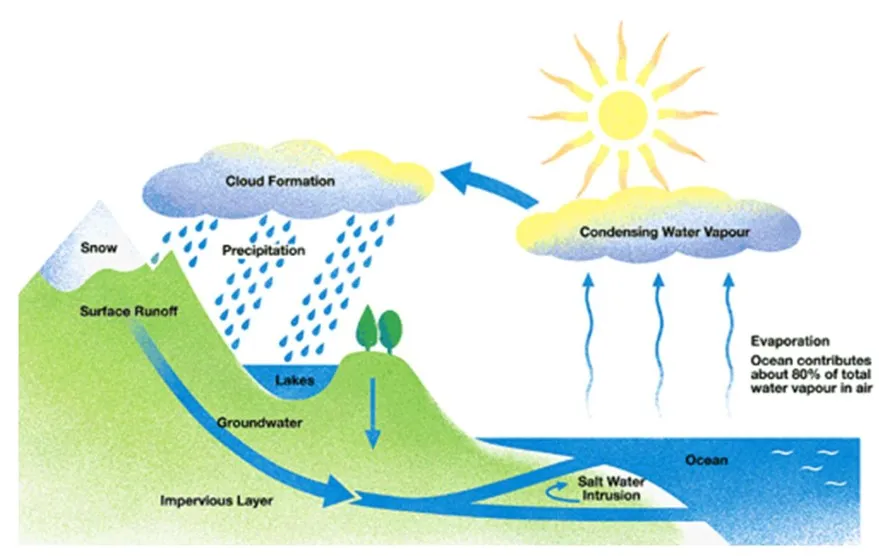
The diagram below shows the water cycle, which is the continuous movement of water on, above and below the surface of the Earth. Summarise the information by selecting and reporting the main features, and make comparisons where relevant. Write at least 150 words.
Part A. Read the diagram.
1. How many main stages does the water go through?
2. How much of the water vapour in the air comes from the ocean?
3. What makes the ocean water evaporate?
4. What does condensing water vapour form?
5. In what two forms does precipitation fall?
6. What happens just before groundwater reaches the ocean?
7. Its shape is …
8. This process is …
Part B. Active or passive? Ask: does someone do it, or does it happen by itself?
9. Heat from the sun causes ocean water to evaporate. Water ____ .
10. Water vapour ____ to form clouds.
11. Water ____ as rain or snow.
12. Salt water intrusion ____ to take place just before groundwater enters the ocean.
Part C. Write. Use active verbs for what the water does.
13. The overview. There is no start or end: say how many stages and what the water does.
.14. The stage 3 paragraph: the paths rainwater takes. Start At the third stage in the cycle, …
.Worksheet 7 key
| # | Answer |
|---|---|
| 1 | 3: evaporation, precipitation, and the paths back (runoff and groundwater) |
| 2 | about 80% |
| 3 | heat from the sun |
| 4 | clouds |
| 5 | rain and snow |
| 6 | salt water intrusion |
| 7 | a cycle that repeats |
| 8 | natural |
| 9 | evaporates |
| 10 | condenses |
| 11 | falls (fall has no passive) |
| 12 | is shown: the diagram shows it, so passive |
| 13 | Open. Model: Three main stages are shown on the diagram. Ocean water evaporates, falls as rain, and eventually runs back into the oceans again. |
| 14 | Open. Model: At the third stage in the cycle, rainwater may take various paths. Some of it may fall into lakes or return to the oceans via ‘surface runoff’. Otherwise, rainwater may filter through the ground, reaching the impervious layer of the earth. Salt water intrusion is shown to take place just before groundwater passes into the oceans to complete the cycle. |
The model report: the water cycle
Open this only when your teacher says. Press Active verbs first, then Passive, and compare with the sugar report.
The picture illustrates the way in which water passes from ocean to air to land during the natural process known as the water cycle.
Three main stages are shown on the diagram. Ocean water evaporates, falls as rain, and eventually runs back into the oceans again.
Beginning at the evaporation stage, we can see that 80% of water vapour in the air comes from the oceans. Heat from the sun causes water to evaporate, and water vapour condenses to form clouds. At the second stage, labelled ‘precipitation’ on the diagram, water falls as rain or snow.
At the third stage in the cycle, rainwater may take various paths. Some of it may fall into lakes or return to the oceans via ‘surface runoff’. Otherwise, rainwater may filter through the ground, reaching the impervious layer of the earth. Salt water intrusion is shown to take place just before groundwater passes into the oceans to complete the cycle.
156 words.