
Aims
By the end of the lesson, students will be able to:
- Describe the format, timing and marking of the IELTS Listening test, and of Parts 1 & 2 specifically.
- Use the seconds before each section to predict what kind of word each gap needs (a number, a name, a noun, a time) and roughly what they will hear.
- Handle the question types that dominate Parts 1 & 2: form / note / table completion, map / plan labelling, and multiple choice / matching, respecting the word limit, spelling and number conventions.
- Recognise a distractor (the moment a speaker corrects, changes or contradicts what they just said) and not write down the first thing they hear.
Anticipated problems and solutions
| Problem | Solution |
|---|---|
| Students write more than the word limit and lose a correct answer | Make the limit visible: box “NO MORE THAN TWO WORDS” on the board and drill a few over-limit answers being marked wrong in Stage 4 |
| Names and places misspelled, so a heard answer is still scored wrong | Spelling-aloud dictation in Stage 4; teach the alphabet-under-pressure and double-letter (“double L”) habit |
| Students write the first thing they hear and miss the correction | Teach the distractor signal explicitly (“actually… sorry… no, make that…”) and drill it; the planted distractors in the scripts exist for this |
| Students fall behind: still writing Q3 while the audio is on Q5 | Rule: let it go. Leave a blank, move on, guess at the end. Board it as a hard rule, not advice |
| Multiple choice: they pick the option whose words they heard | Show that the audio paraphrases the right option and often says the wrong options’ words out loud as bait |
| Numbers and dates: fifteen/fifty, date order, phone numbers | Quick number-discrimination drill; teach “double” for repeated digits and the o/“oh” habit |
| Mixed level (one well below, or one who has already sat the test) | Below level: pause the script, or give the map with two labels pre-filled. Already sat it: give them the answer key and let them mark a peer in Stage 6 |
Materials
Question sheets (Appendix A), one per student, do not hand out the scripts. Teacher scripts and answer key (Appendix D), for you only. Self / peer check sheet (Appendix B). Board/markers. A timer, visible to the room. You are the audio: read the scripts at a natural, steady pace. You may slow slightly for numbers and spelling, but resist the urge to over-help.
Timing map
| Stage | Min | |
|---|---|---|
| 1 | Listening test overview + Parts 1 & 2 | 10 |
| 2 | The skill that changes everything: prediction | 15 |
| 3 | Diagnostic: a cold Part 1, then replay the traps | 20 |
| 4 | Core fix: completion tasks | 25 |
| Break | 10 | |
| 5 | Section 2: map / plan labelling | 12 |
| 6 | Section 2: multiple choice & matching | 18 |
| 7 | Full practice: a Part 2 + self / peer check | 15 |
| 8 | Wrap-up and homework | 5 |
| Total | 130 |
The load here is the reverse of the Speaking lessons: this is a receptive skill, so the room is quieter and the risk is that it goes passive. Keep them writing, predicting and self-marking at every stage. If you are behind by Stage 6, keep the multiple-choice teach and cut the extra matching / choose-THREE rep.
Procedure
Stage 1: Listening test overview + Parts 1 & 2 (10 min)
Interaction: teacher-led
Goal: give students the shape of the whole Listening test and show them why Parts 1 & 2 are the part they can win.
You need: the board; the table and check-questions below.
- (3 min) Show the shape of the test. Put the table below on screen (or draw the four parts on the board). Say the key facts out loud: “40 questions, about 30 minutes of audio, and you hear each recording only once.” Add: on the paper test you get 10 minutes at the end to copy your answers over; on the computer test you only get 2 minutes. One mark each, spelling and word limit count.
Part Situation Who's speaking Typical tasks 1 Everyday / social Two people (an enquiry, a booking) Form / note / table completion 2 Everyday / social One person (a talk, a tour) Map / plan labelling, multiple choice, matching 3 Educational Up to four people (a tutorial) Matching, multiple choice, completion 4 Academic One person (a lecture) Note / sentence completion - (3 min) Say why Parts 1 & 2 are winnable. They're the everyday half: a phone enquiry, a booking, a tour. Tell them: “The hard part is keeping up and not being tricked, not the words.” Stress that Part 1 is the easiest section in the whole test: slow, concrete (names, dates, prices), and it always gives you an example answer first.
- (2 min) Kill the three myths, say each one out loud:
- You can't “catch up” a recording. Miss one answer? Leave it: that's one mark; freezing over it costs you the next three.
- The answer is rarely the first thing you hear; speakers change their mind mid-sentence on purpose.
- A right answer spelled wrong is a wrong answer.
- (2 min) Check they've got it. Ask the three questions below and get the answers back from the class before moving on.
Check questions
- How many times do you hear the recording? (Once)
- If you miss an answer, do you stop and wait? (No, leave it, move on)
- Is a correctly heard but misspelled name a mark? (No)
Stage 2: The skill that changes everything: prediction (15 min)
Interaction: teacher-led, then pairs
Goal: teach the one habit that lifts a 6 to a 7: reading the gaps and deciding what kind of word goes in each one before the audio starts. This stage has no audio at all.
You need: the board; Worksheet 1 (the Part 1 table) on screen.
- (5 min) Teach Predict → Listen → Check. Write it on the board and explain each step. Tell them the difference plainly: “Weak candidates start listening cold. Strong ones have already decided gap 3 is a price and gap 5 is a surname they'll have to spell.”
Predict → Listen → Check
Predict. What kind of word is missing: a number, a name, a time, a place, a plural noun? And what might it be?
Listen. Now you know what you're hunting for. Wait for that type of word, and stay alert for the speaker changing it.
Check. Does your answer fit the gap grammatically, and is it inside the word limit?
The first 30 seconds: do this on every task before the audio
- Circle the word limit (e.g. “NO MORE THAN TWO WORDS”) so you never lose a right answer by writing too much.
- Read the title (e.g. “Travel agency”) to fix the topic in your head.
- Read the questions.
- Underline the keyword in each one: the word you'll listen for.
- Predict the word type for every gap.
- (2 min) Put Worksheet 1 on screen, do not play any audio. Tell them they're only going to predict, not listen.
- (5 min) In pairs, they label every gap with the word type they expect: number · name · time · place · plural noun. Where they write plural noun, remind them the -s is a mark on its own (they'll drill this on Worksheet 10).
- (3 min) Take feedback. Any gap where pairs disagree is exactly where the exam trips people: mark those gaps; you'll watch them in Stage 3.
Stage 3: Diagnostic: a cold Part 1, then replay the traps (20 min)
Interaction: on their own, then teacher-led
Goal: students do a real Part 1 once, then discover for themselves where they lost marks. Don't tell them the traps; let them catch them.
You need: Worksheet 1, the Part 1 audio, the board.
- (1 min) Hand out Worksheet 1 (the same table they predicted on in Stage 2). Say: “30 seconds: re-read your predictions.”
- (4 min) Play the Part 1 audio once, at a natural pace, start to finish. Do not pause, do not repeat. Students fill in the table on their own. Collect nothing: this sheet stays theirs.
- (3 min) Pairs compare, but change nothing. Say: “Compare with your neighbour. Do NOT change your answers — just tick every gap where the two of you wrote something different.”
- (5 min) Find the traps together. On the board, write the 2–3 gaps most pairs disagreed on: those are the traps built into the recording. Ask: “I'll play just these lines again. Why did some of you hear one answer and some another?”
- (5 min) Replay only those lines. Let a student catch it out loud: “Oh, she said the third of June and then changed it to the seventeenth.” Point them at the signals below so they know what a change of mind sounds like.
- (2 min) Private note before moving on. Each student writes one sentence, just for themselves: “The thing most likely to cost me marks in Listening is ______.” Not collected: you come back to it in Stage 7.
While the audio plays: keep these going
- Stay 2–3 questions ahead, not just on the next one. If you miss one, you rejoin at the following question instead of losing the whole section waiting.
- Write it the moment you hear it, even if you're unsure. They may change it (“thirty… no, forty”). If you wait, you lose the first one; if it doesn't change, you've already got it.
- Unsure of a spelling? Mark it with a “?” and move on. You can fix it in the checking time at the end. The questions won't come back, so don't stall on doubt.
- Every pause is reading time. Use each gap to read the next questions; never sit and wait.
Stage 4: Core fix: completion tasks (25 min)
Interaction: teacher-led, then on their own
Goal: fix the three things that throw away a completion answer even when the student heard it correctly: going over the word limit, misspelling, and mangling numbers. Do them as three short drills, then re-run a form so they feel the difference.
You need: the board; Worksheet 8 and Worksheet 9 (dictation) and Worksheet 4 (re-run); the live room started for step 3.
Drill 1 · The word limit (8 min)
- Write the limit on the board: “NO MORE THAN TWO WORDS AND/OR A NUMBER”.
- Mark four sample answers right or wrong together using the box below: let the class call out ✓ or ✗ before you reveal it.
- Draw the lesson: write numbers as numerals (9.30, not “half past nine”). It saves words and can't break the limit.
- Circle the symbol if the gap already prints one (£, $, %): then write only the number. Writing “ten dollars” after a printed $ doubles it and loses the mark.
Gap: The tour leaves at ___.
Heard: "…the morning tour leaves at half past nine."
  half past nine            ✗ (three words)
  9.30                      ✓
  9.30 am                   ✓ (a number + one word)
  the morning tour at 9.30  ✗ (way over)
Drill 2 · Spelling under pressure (8 min)
- Explain the point: in the test they don't spell aloud: they hear letters and have to write them. Don't drill the whole alphabet; drill only the letters that sound alike (the table below), because that's where a heard name gets misspelled and loses its mark.
- Teach the spoken shorthands in the second box below (“double L”, “capital”, apostrophe, hyphen, “at”/“dot”), and the double-letter trick both ways: “that's B-double-O-T-H” = BOOTH.
- Run the drill: spell out Worksheet 8 aloud, one item at a time, once each, while students write. The answer next to each item on your screen is what to spell (students don't see it).
The alphabet aloud — say each letter as it sounds, then drill the confusable pairs below
| Letter | Say | Letter | Say | Letter | Say |
|---|---|---|---|---|---|
| A | “ay” | B | “bee” | C | “see” |
| D | “dee” | E | “ee” | F | “ef” |
| G | “jee” | H | “aitch” | I | “eye” |
| J | “jay” | K | “kay” | L | “el” |
| M | “em” | N | “en” | O | “oh” |
| P | “pee” | Q | “cue” | R | “ar” |
| S | “es” | T | “tee” | U | “you” |
| V | “vee” | W | “double-u” | X | “ex” |
| Y | “why” | Z | “zed” (UK) |
| Confused letters | Sounds like | Watch out for |
|---|---|---|
| A and E and I and R | “ay” · “ee” · “eye” · “ar” | most-confused vowels; in UK speech R (“ar”) sounds close to A |
| J and G | “jay” · “jee” | both start with a /dʒ/ sound |
| C and S | “see” · “es” | both carry an /s/ sound; C/S swap in names |
| B and P and V | “bee” · “pee” · “vee” | same mouth shape; B/P/V blur at speed |
| M and N | “em” · “en” | nasal pair: hard to split in fast speech |
| W | “double-u” | not a “V”; two syllables |
| H | “aitch” | no “h” sound at the front |
| Y | “why” | sounds like a whole word |
| Z | “zed” (UK) | British test says zed, not “zee” |
"double L"      = LL      (accommodation, address)
apostrophe      = O'Brien
hyphen          = Smith-Jones
"at"            = @        "dot" = .   (email addresses)
(write all answers in CAPITALS — capitalisation is never marked)
Drill 3 · Numbers, dates & prices · live (9 min)
- Write the four number traps on the board (the box below): 13 vs 30, “double/treble/oh”, date order, and price/unit symbols.
- Start the live room (button at the top of this page) and have students open Worksheet 9 on their phones with the room link.
- Dictate the list once each, at a natural pace: don't spell, don't repeat. The item to read and its answer show next to each question on your screen only. The dashboard marks every phone green/red as they type.
- Replay the reds: whichever gaps go red across the room (usually 13/30, the date order, the “double”) are the ones to say again and unpick.
- Fix one date format: whatever they say (“the fifth of March,” “March the fifth”), always write number + month (5 March). It saves words and dodges the th/st/rd slips.
13 vs 30    stress problem, not vocabulary  (thir-TEEN / THIR-ty)
"double" 77 = 77   "treble/triple" 8 = 888   "oh" = 0
dates: hear "the third of May" → write 3 May  (numerals save words)
prices/units: £, %, .5 (point five), per person, write the symbol
(3 min) Re-run to lock it in: read the short Worksheet 4 note-completion once; students apply all three rules at once (limit, spelling, numbers) and mark their own against the key.
Stage 5: Section 2: map / plan labelling (12 min)
Interaction: teacher-led, then on their own
Goal: teach one Part 2 format (reading a map from the language of position and direction), then practise a map for real.
You need: the board; the position-language table below; Worksheet 6 (the map, with audio).
- (4 min) Teach the direction language. Show the table below and explain the key idea: the answer almost always comes right after one of these phrases, so they're the signal to write.
- (2 min) Put up Worksheet 6 (the Rosewood map). Before any audio, students find the entrance first, then read the list of letters they have to place.
- (4 min) Play the Worksheet 6 audio once. Students write a letter next to each label as they hear it.
- (2 min) Mark it together and replay any label the class got split on.
| They say | It means |
|---|---|
| as you come in / at the entrance | your starting point: orient here first |
| on your left / right, to your left | direction from where you’re “standing” |
| straight ahead / at the far end / at the back | opposite the entrance |
| next to / beside / adjacent to | touching the thing just named |
| opposite / facing / across from | the other side, looking at it |
| between X and Y | boxed in on two sides |
| just past / beyond / round the corner from | a bit further than the last landmark |
| in the corner / on the corner | where two edges meet |
Stage 6: Section 2: multiple choice & matching (18 min)
Interaction: teacher-led, then on their own
Goal: teach the three “choose a letter” formats of Part 2 (single multiple choice, matching, and choose-THREE), which all rest on one skill: hearing the meaning, not the exact words.
You need: the board; Worksheet 11 (paraphrase warm-up); Worksheet 2 (multiple choice + choose-THREE); Worksheet 3 (matching).
(3 min) Warm up with Worksheet 11. Read each spoken phrase aloud; students write the plain meaning. This is the one skill all three formats depend on: hearing the meaning, not the words.
Part A · Single multiple choice · A / B / C (5 min)
- Teach the rule in the box below, with the example: the audio says “well out of my price range,” the answer is the option that says “too expensive,” even though “expensive” was never spoken.
- Teach “eliminate, don't select”: cross options off as the speaker rules them out, rather than hunting for the right one.
- Shorten the options before the audio: cut each one to a keyword or number: “two years / three years / five years” becomes “2 / 3 / 5.” Less to read means you can listen instead of re-reading while the speaker talks.
Part B · Matching · a list of options, A–G (5 min)
- Show the shape using Worksheet 3 (Rivenden Theatre): a bank of options A–G, and a list of items to label. The items come up in the order you hear them; the options do not, so you can't just work down the list.
- Read every option first, before the audio. There are more options than items, so some are never used.
- Cross an option off as you place it, and listen for the paraphrase: the same “meaning not words” skill as multiple choice.
- Don't get stuck: if one item beats you, leave it blank and move on; freezing on it costs you the next answer too.
Part C · Choose THREE letters, A–G (5 min)
- Show the shape using Worksheet 2, Q18–20: one question, seven options, and you pick the three correct ones. It counts as three answers.
- Order doesn't matter: any three correct letters score full marks: they don't have to match the box order.
- Listen to one stretch of talk: all three answers come from the same passage, close together, not spread across the whole section.
- Watch the “mentioned then rejected” trap: the speaker often names an option only to rule it out (“we used to…,” “not this year”). Hearing the word is not enough: only what they actually do counts.
- Write letters, not words. If unsure at the end, put a plausible letter in every blank; there's no penalty for a guess.
Check questions
- In matching, can the same option be used for two different items? (No, each option is used once; there are more options than items, so some go unused.)
- In a choose-THREE question, does the order you write the letters in matter? (No, any three correct letters score full marks.)
- The speaker says a word that matches option B, then says “but not any more.” Is B an answer? (No: it was mentioned then rejected. Only what they actually do counts.)
Stage 7: Full practice: a Part 2 + self / peer check (15 min)
Interaction: on their own, then pairs
Goal: one full, uninterrupted multiple-choice Part 2 under real test conditions, applying the “paraphrase then eliminate” rule from Stage 6, then students mark it themselves and work out which trap caught them.
You need: Worksheet 2 (a full multiple-choice Part 2, with audio); the check sheet in Appendix B.
- (1 min) Hand out Worksheet 2 (the Bicycles for the World multiple-choice task). Give 30 seconds to read the options and predict.
- (4 min) Play the audio once, start to finish, no stops: treat it exactly like the real test.
- (4 min) Students mark their own against the key (or swap and mark a partner's).
- (4 min) Everyone fills in the check sheet (Appendix B): score per question, how sure they were, and the one trap that caught them.
- (2 min) Round up: pick 2–3 students to name out loud the trap or word-limit slip they'll now watch for.
Spare: Worksheet 3 (matching · Rivenden Theatre) is a ready second Part 2 if a group finishes early or you want a matching rep.
Stage 8: Wrap-up and homework (5 min)
Interaction: teacher-led
Goal: pull the lesson together by getting the four takeaways from the students (ask them, don't tell them), then set homework that trains single-listen awareness.
You need: the board; the private sentence each student wrote in Stage 3.
- (3 min) Recap by asking, not telling. Draw these four out of the class and write each on the board as a student says it:
- Read ahead and predict the word type before the audio starts.
- Let it go: a missed answer is one mark; freezing costs three.
- Watch for the change of mind: the answer is rarely the first thing said.
- Heard right still loses if it's over the limit or misspelled.
- (1 min) Call back to Stage 3. Say: “Look again at the sentence you wrote at the start: the thing most likely to cost you marks. Is it still the one?” Ten seconds, silent, no need to share.
- (1 min) Set the homework in the box below and check they know it's a single listen, no re-listening.
Teacher Notes
Appendix A · Question Sheets
One per student. Do not hand out the scripts in Appendix D.
Question-type playbook
| Question type | What wins it |
|---|---|
| Form / note / table completion | Predict the word type per gap; stay within the word limit; spell names right (they’re usually spelt out). Numbers can be written as figures or words; both are marked correct, so use whichever is faster |
| Map / plan labelling | Find the reference point first (‘you are here’, the entrance, a fixed landmark, or the compass) and track direction and position words (opposite, just past, at the far end); the answer follows the signpost from that anchor |
| Multiple choice | The right answer is usually a paraphrase, not the words as spoken; distractors often repeat words you hear, but not always, and the correct option can echo them too. Hearing a word is a weak signal, not proof it’s wrong: weigh meaning, don’t auto-eliminate |
| Matching | Questions run in the order you hear them, options don’t; read all options first; don’t get stuck — leave a blank and move on. Only cross an option off once you’ve placed it if the rubric says each is used once — options may be reused or unused |
| Choose THREE letters | Order doesn’t matter; the trap is options mentioned then rejected; write letters, not words. The three often cluster in one stretch, but can be spread with distractors between — keep listening to the end |
Worksheet 1 · Part 2 — Comparing cots(table completion)
Cambridge IELTS 5 · Test 1 · Section 2
Comparing cots
Complete the table. Write NO MORE THAN THREE WORDS for each answer.
| Brand of Cot | Good Points | Problems | Verdict |
|---|---|---|---|
| Baby Safe | Easy to 11 |
| 14 |
| Choice Cots | Easy to 15 |
| 17 |
| Mother's Choice | Base of cot could be moved |
| 19 |
Worksheet 2 · Part 2 — Bicycles for the World(multiple choice)
Cambridge IELTS 5 · Test 2 · Section 2
Bicycles for the World
Choose the correct letter, A, B or C. Write it in the box.
11. In 1993 Dan Pearman went to Ecuador 11
A. as a tourist guide.
B. as part of his studies.
C. as a voluntary worker.
12. Dan's neighbour was successful in business because he 12
A. employed carpenters from the area.
B. was the most skilled craftsman in the town.
C. found it easy to reach customers.
13. Dan says the charity relies on 13
A. getting enough bicycles to send regularly.
B. finding new areas which need the bicycles.
C. charging for the bicycles it sends abroad.
14. What does Dan say about the town of Rivas? 14
A. It has received the greatest number of bikes.
B. It has almost as many bikes as Amsterdam.
C. Its economy has been totally transformed.
15. What problem did the charity face in August 2000? 15
A. It couldn't meet its overheads.
B. It had to delay sending the bikes.
C. It was criticised in the British media.
Questions 16 & 17 — answer the questions. Write NO MORE THAN ONE WORD OR A NUMBER for each answer.
How much money did the charity receive when it won an award? 16
What is the charity currently hoping to buy? 17
Questions 18–20 — choose THREE letters, A–G.
Which THREE things can the general public do to help the charity Pedal Power?181920
A. organise a bicycle collection
B. repair the donated bikes
C. donate their unwanted tools
D. do voluntary work in its office
E. hold an event to raise money
F. identify areas that need bikes
G. write to the government
Worksheet 3 · Part 2 — Rivenden City Theatre(matching)
Cambridge IELTS 6 · Test 1 · Section 2
Rivenden City Theatre
What change has been made to each part of the theatre? Choose the correct letter, A–G, and write it next to Questions 11–16.
RIVENDEN CITY THEATRE
A. doubled in number
B. given separate entrance
C. reduced in number
D. increased in size
E. replaced
F. strengthened
G. temporarily closed
Part of the theatre
11. box office 11
12. shop 12
13. ordinary seats 13
14. seats for wheelchair users 14
15. lifts 15
16. dressing rooms 16
Worksheet 4 · Part 1 — Library information(note completion)
Cambridge IELTS 5 · Test 2 · Part 1
Library information
Complete the notes below. Write NO MORE THAN THREE WORDS AND/OR A NUMBER for each answer.
LIBRARY INFORMATION
(Example) Minimum joining age: 18 years
For registration, must take
- two 1 and
- two forms of I.D. e.g. driving licence, 2
Cost to join per year (without current student card): £ 3
Number of items allowed: (members of public) 4
Loan times: four weeks
Fines start at £ 5
Computers can be booked up to 6 hours in advance
Library holds most national papers, all 7, and magazines
Need 8 to use photocopier
Creative Writing class
- tutor is John 9
- held on 10 evenings
Worksheet 5 · Part 1 — Host family applicant(form completion)
Cambridge IELTS 5 · Test 4 · Section 1
Host family applicant
Complete the form below. Write NO MORE THAN THREE WORDS AND/OR A NUMBER for each answer.
HOST FAMILY APPLICANT
(Example) Name: Jenny Chan
Present address: Sea View Guest House, 1
Daytime phone number: 2237676
- [N.B. Best time to contact is 2 am]
Age: 19
Intended length of stay: 3
Occupation while in UK: student
General level of English: 4
Preferred location: in the 5
Special diet: 6
Other requirements:
- own facilities
- own television
- 7
- to be 8
Maximum price: £ 9 a week
Preferred starting date: 10
Worksheet 6 · Part 2 — A tour of Rosewood(map labelling + sentence completion)
Cambridge IELTS 6 · Test 3 · Section 2
A tour of Rosewood
Label the map below. Choose the correct letter, A–J, next to Questions 14–17.
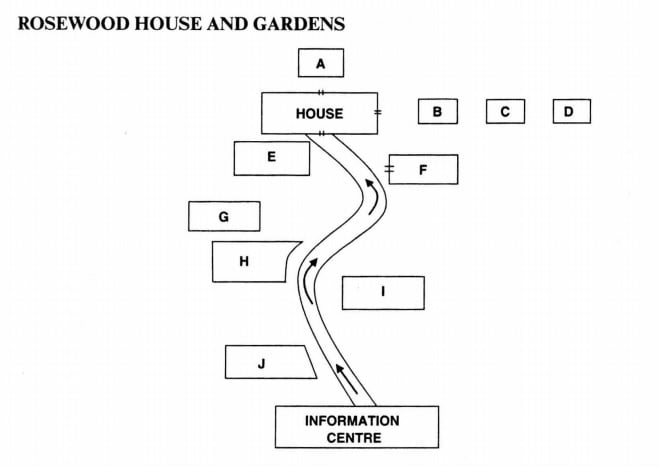
14. Pear Alley 14
15. Mulberry Garden 15
16. Shop 16
17. Tea Room 17
Questions 18–20 — complete the sentences below. Write ONE WORD ONLY for each answer.
RIVER WALK
18. You can walk through the 18 that goes along the river bank.
19. You can go over the 19 and then into a wooded area.
20. On your way back, you could also go up to the 20.
Worksheet 7 · Part 2 — Water heater(diagram labelling)
Cambridge IELTS 9 · Test 4 · Section 2
Water heater
Label the diagram below. Choose the correct letter, A–E, next to Questions 11–13.
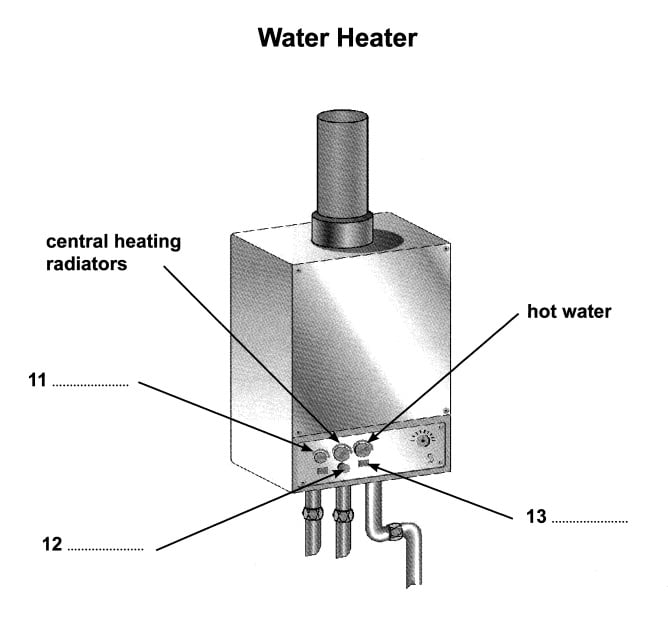
11 11
12 12
13 13
A. electricity indicator
B. on/off switch
C. reset button
D. time control
E. warning indicator
Live drills · teacher reads aloud — no audio
Worksheet 8 · Spelling dictation(names · places · codes)
Teacher-spelled · no recording · marked live
Your teacher spells each item once. Write exactly what you hear — letter for letter. Listen for “double”, the apostrophe, and the tricky pairs (G/J, C/S, B/P/V, E/I).
Exam takeaway: in the real test, write every answer in CAPITAL LETTERS. It's never marked wrong, and you stop wasting attention on which letters are capitals — spend it all on getting the spelling right.
Surnames
1. 1🔊 WEST — say “west” — spell “W (double-u) – E – S – T” (easy: short, W not V)
2. 2🔊 KELLY — say “KEL-ee” — spell “K – E – double-L – Y” (the “double” shorthand)
3. 3🔊 GRACE — say “grayss” — spell “G – R – A – C – E” (confusable: G not J; C sounds like S)
4. 4🔊 JENNINGS — say “JEN-ingz” — spell “J – E – double-N – I – N – G – S” (confusable: J vs G in one name; E/I)
5. 5🔊 PICKFORD — say “PIK-ferd” — spell “P – I – C – K – F – O – R – D” (confusable: P not B/V; C/K)
6. 6🔊 STEPHENSON — say “STEE-vun-sun” — spell “S – T – E – P – H – E – N – S – O – N” (P-H trap: write P-H, not F)
7. 7🔊 O’BRIEN — say “oh-BRY-un” — spell “O – apostrophe – B – R – I – E – N” (hardest: apostrophe)
Places & streets
8. 8🔊 YORK — say “york” — spell “Y – O – R – K” (easy: short, 4 letters)
9. 9🔊 NEWCASTLE — say “new-KAH-sul” — spell “N – E – W – C – A – S – T – L – E” (confusable: C then S; W not V; N/M)
10. 10🔊 EDINBURGH — say “ED-in-bruh” — spell “E – D – I – N – B – U – R – G – H” (longer; -URGH ending)
11. 11🔊 LEICESTER RD — say “LES-ter road” — spell “L – E – I – C – E – S – T – E – R, R – D” (hard: spelling ≠ sound; C/S + E/I; RD)
Codes & reference numbers
12. 12🔊 BK472 — “B – K – four – seven – two”
13. 13🔊 QT2200 — “Q – T – two – two – oh – oh”
14. 14🔊 VP38B — “V – P – three – eight – B” (confusable: V vs P vs B in a row)
15. 15🔊 AA779Z — “double-A – double seven – nine – Z (zed)”
Email address
16. 16🔊 j.smith@mail.com — “J – dot – smith – at – mail – dot – com”
17. 17🔊 info@learne.org — “info – at – learne – dot – org”
Worksheet 9 · Numbers, dates & prices(live dictation)
Teacher-dictated · no recording · marked live
Your teacher reads each item once. Write numbers as numerals(9.30, not “half past nine”). Listen for “double” / “treble”, “oh” for zero, and the teen/ten trap (13 vs 30).
Teens vs tens — write the numeral
1. 1🔊 “thirTEEN” → 13
2. 2🔊 “THIRty” → 30 (pair with 13)
3. 3🔊 “fourTEEN” → 14
4. 4🔊 “FORty” → 40 (pair with 14)
5. 5🔊 “fifTEEN” → 15
6. 6🔊 “SIXty” → 60
7. 7🔊 “sevenTEEN” → 17
8. 8🔊 “NINEty” → 90
Dates & times
9. Date: 9🔊 “the third of May” → 3 May
10. Opening time: 10🔊 “we open at quarter past nine in the morning” → 9.15 am
11. Date: 11🔊 “the twenty-second of November” → 22 November
12. Closing time: 12🔊 “the last tour leaves at half past seven” → 7.30 pm
13. Built in the: 13🔊 “the hall was built in the nineteen-nineties” → 1990s
Phone & reference numbers
14. Mobile: 14🔊 “oh seven seven, double oh, nine double oh, one two three” → 07700 900123
15. Reference: 15🔊 “the reference is three four, double seven, two” → 34772
16. Door code: 16🔊 “the door code is one two, treble eight, five” → 128885
Prices & measurements
17. Price: 17🔊 “that’s nineteen ninety-nine” → £19.99
18. Discount: 18🔊 “there’s fifty per cent off” → 50%
19. Distance: 19🔊 “it’s two point five kilometres from here” → 2.5 km
20. Entry per person: 20🔊 “entry is fourteen pounds fifty each” → £14.50
Worksheet 10 · Singular or plural?(live dictation)
Teacher-dictated · no recording · marked live
Your teacher reads a short phrase once. Write only the noun, exactly as you hear it — with or without the -s. The whole test is whether you caught the ending.
Clear -s endings — write the plural
1. 1🔊 “you’ll need two return tickets” → tickets
2. 2🔊 “here’s a list of ingredients” → ingredients
The -s is easy to miss at speed
3. 3🔊 “check the opening hours first” → hours
4. 4🔊 “she asked for the sales figures” → figures
Genuinely singular — don't add -s
5. 5🔊 “it’s next to the museum shop” → shop
6. 6🔊 “leave it in the staff car park” → car park
Plural without a simple -s
7. 7🔊 “the children’s books are upstairs” → children’s books
8. 8🔊 “go to the women’s section” → women’s section
Worksheet 11 · Paraphrase warm-up(live)
Teacher-read · no recording · teacher-marked
Your teacher reads what a speaker says. Write the plain, exam-option meaningin one or two words — the exam never repeats the speaker's exact words.
1. “well out of my price range” → 1🔊 expensive / too dear
2. “I'm not too keen on it” → 2🔊 dislike / don’t like
3. “it completely slipped my mind” → 3🔊 forgot
4. “it's just a stone's throw away” → 4🔊 near / close
5. “they're run off their feet” → 5🔊 very busy
6. “it didn't live up to the hype” → 6🔊 disappointing
Appendix B · Self / Peer Check Sheet
Mark your own sheet (or a partner's) against the answers. Be honest about which ones you guessed— that's the useful information.
| Q | Right | Guessed it | Wrong |
|---|---|---|---|
| 1 | ○ | ○ | ○ |
| 2 | ○ | ○ | ○ |
| 3 | ○ | ○ | ○ |
| 4 | ○ | ○ | ○ |
| 5 | ○ | ○ | ○ |
| 6 | ○ | ○ | ○ |
Why did you lose the ones you lost?over the word limit · spelling · caught by a distractor · fell behind · number/date · picked the words I heard. The one distractor that caught me: ____
Appendix C · Board Plan
LEFT (leave up all lesson):
  LISTENING = 4 parts · 40 Qs · heard ONCE
  Parts 1 & 2 = everyday. Winnable.
  RULES:  Predict the word TYPE first
          Miss one? LET IT GO (1 mark, not 4)
          Answer changes mid-sentence — keep listening

CENTRE (keep to the end):
  PREDICT  →  LISTEN  →  CHECK
   word type?   hunt it    fits gap? in limit?

  NO MORE THAN TWO WORDS AND/OR A NUMBER
    numbers as numerals: 9.30 not "half past nine"
    "double L" = LL   traps: G/J  B/P/V  E/I  Z=zed
    ALPHABET drill → Worksheet 8: names · places · codes · email
    NUMBERS drill → Worksheet 9 (live): dates · phone · prices
    13 vs 30 (stress) · "double 7" · "oh" = 0
    PLURALS → Worksheet 10: did you hear the -s?

RIGHT (Stage 5):
  PARAPHRASE warm-up → Worksheet 11: option = MEANING, not words
  MAP: find the ENTRANCE first
    on your left / straight ahead / at the far end
    opposite · next to · between · just past
  MULTIPLE CHOICE:
    answer = PARAPHRASE   wrong options = the words you HEAR
    eliminate, don't select
Appendix D · Answer Key (recorded sets)Teacher only
Worksheet 1 — Part 2 table completion (comparing cots · Cambridge IELTS 5, Test 1, Section 2)
Answers: 11 move around · 12 brakes · 13 fingers · 14 satisfactory · 15 put together · 16 too wide · 17 dangerous · 18 wheels · 19 best buy
Worksheet 2 — Part 2 multiple choice (Bicycles for the World · Cambridge IELTS 5, Test 2, Section 2)
Answers: 11 C · 12 C · 13 A · 14 C · 15 A · 16 £75,000 · 17 computers · 18–20 C / E / F (any order)
Worksheet 3 — Part 2 matching (Rivenden City Theatre · Cambridge IELTS 6, Test 1, Section 2)
Answers: 11 B · 12 G · 13 C · 14 A · 15 E · 16 D
Worksheet 4 — Part 1 note completion (Library information · Cambridge IELTS 5, Test 2, Part 1)
Answers: 1 passport photos · 2 bank statement · 3 125 · 4 8 · 5 1.50 · 6 48 · 7 local papers · 8 card · 9 Grantingham · 10 Friday
Worksheet 5 — Part 1 form completion (Host family applicant · Cambridge IELTS 5, Test 4, Section 1)
Answers: 1 14 Hill Road · 2 between 9 and 9.30 · 3 1 year · 4 Intermediate · 5 North-West · 6 vegetarian · 7 real garden · 8 only guest · 9 100 · 10 23rd March
Worksheet 6 — Part 2 map labelling + sentence completion (A tour of Rosewood · Cambridge IELTS 6, Test 3, Section 2)
Answers: 14 H · 15 F · 16 B · 17 D · 18 field · 19 footbridge · 20 viewpoint
Worksheet 7 — Part 2 diagram labelling (Water heater · Cambridge IELTS 9, Test 4, Section 2)
Answers: 11 B · 12 C · 13 E